The Controlled Weapons Department was created in 1946, within the Royal Aircraft Establishment (RAE) of Farnborough. The Rocket Propulsion Establishment (RPE) was created in Westcoot at the same time. These two organizations were going to initiate the development of all the British activity with regard to rocket propulsion and guidance.
Skylark rocket development
As part of the studies undertaken at the RAE in early 1950s, a series of experimental vehicles were studied, among which the CTV5 Series 3 able to send a 45 kg payload to more than 150 km of altitude.
The Gassiot Committee of the Royal Society had defined, since 1941-43, a program of upper atmosphere
research. In May 1953, the committee accepted a Ministry of Equipment proposal for using the available
rockets with a view to doing atmospheric surveys. In 1955, after a thorough study of the scientists
needs and existing rockets, it appeared that the RAE was to be able to provide a rocket capable of
launching 45 kg to 210 km of altitude for the International Geophysical Year of 1957.
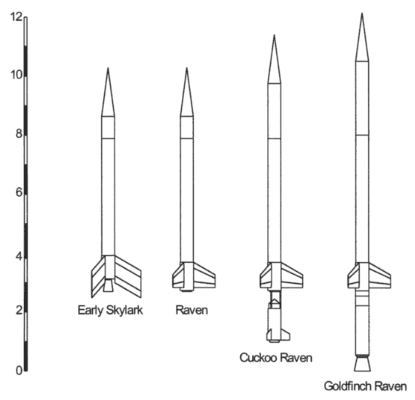
This rocket, designated Skylark from 1956 forward, was to be 7.60 m long, 44 cm in diameter
and 96 cm span. The Raven engine, provided by RPE, burned its 840 kg propellant load (ammonium perchlorate,
polyisobutylene binder and aluminium powder) in about thirty seconds. The first model, Raven I,
who provided a 1450 kNs total impulse at sea level, was replaced in 1958 by a 1540 kNs Raven II.
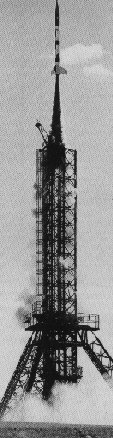
The relatively weak thrust (about 50 kN) made the vehicle sensitive to the wind, which required
the construction of a 25 m high launching tower weighing 30 tons, swiveling (within about ten
degrees) on two axes.
A first series of six technological launches was carried out from the Woomera rocket range,
in Australia, on and after February 1957. The first three launches having succeeded perfectly,
the scientific experiments began as of the fourth launch in November 1957.
After twenty-two launches in single-stage configuration, the first two-stage Skylark was
launched in April 1960. The Cuckoo booster rocket used to accelerate Raven had the same diameter
and raised the overall rocket height to 9.15m. It burned during approximately four seconds with
a 364 kNs total impulse. This version of Skylark could launch a 150 kg payload to 200 km of
altitude. The Skylark improvements continued in 1962, with the advent of Raven V (1780 kNs)
loaded with a new propellant. However Raven II and VA engines were both available to meet
different needs. Minor modifications led to VII and VIA versions respectively, then Raven VII
loaded with Raven VI propellant became Raven VIII. In 1964, introduction of devices for payload
attitude control was another kind of improvement for the Skylark rocket.
Launches from Europe
The year 1964 saw the first flights carried out on behalf of the ESRO. These first launches from Europe took place in Salto di Quirra (Sardinia), then in Kiruna (Sweden) in 1968.
A new booster rocket, Goldfinch with a 700 kNs total impulse, appeared in February 1968. Maximum altitude with 100 kg payload grew to 380 km with a Raven VI upper stage (Skylark 6) and to 330 km with Raven VIII (Skylark 4). The fast burning Cuckoo III (407 kNs) for short-rail launches, was put into service in 1972.
The ESRO sounding rockets program ended in 1972 with 82 Skylark rockets launched. However, the British national program was not the only user of Skylark because the German program had started to use this type of rockets since 1970.
Current versions
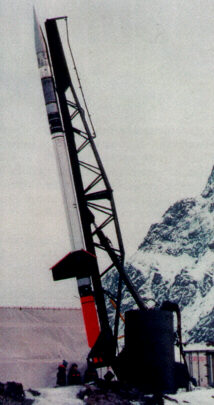
The gradual improvements of the sustainer led to the 2230 KNs Raven XI in the late 1974. The most recent versions of this engine comprise 990 kg of propellant and provide more than 2500 KNs in 39 seconds. Used lonely (Skylark 5) it can send a 200 kg payload to 210 km of altitude. With a Goldfinch IIA booster (Skylark 7), the apogee reached with the same payload exceeds 400 km. This version weighs 1700 kg and measures 7.94 m in length (without payload). The most powerful version is Skylark 12; it is a Skylark 7 vehicle equipped with a Cuckoo IV third stage which delivers 452 kNs in about fifteen seconds. Skylark 12 weighs 1935 kg and measures 9.25 m (without payload) and culminates at 575 km with a 200 kg payload. Its first launch occurred in November 1976.
The British sounding rockets program was completed in early 1979 with a total of 266 Skylark launched. Since this date, Skylark launches are carried out by German and Swedish organizations within the framework of national programs or on behalf of the ESA. Today, only the TEXUS and MASER programs of microgravity experiments use this type of sounding rockets, whose manufacture is ended. There are still four Skylark remaining to be launched by German company DASA.
Tables
a/ Skylark rockets evolution
b/ Skylark launch sites distribution
c/ Skylark launches on behalf of the British national program
d/ Skylark launches on behalf of NASA
e/ Skylark launches on behalf of ESRO
f/ Skylark launches on behalf of German organizations
g/ Skylark launches on behalf of Swedish organizations
Listings after James Wentworth, Jonathan McDowell and Geof O'Callaghan data
Links
Australian Space Research Institute (ASRI) - Australian Launch vehicles
Mobile Rocket Base (DLR)
Scale in meters
| Type | Booster | Sustainer | 3rd stage | 1st flight |
|---|---|---|---|---|
| - | Raven I | - | 1957 | |
| - | Raven II | - | 1958 | |
| Cuckoo | Raven II | - | 1960 | |
| Cuckoo | Raven V | - | 1962 | |
| Cuckoo | Raven VII | - | 1962 | |
| 1 | - | Raven VIII | - | 1966 |
| 2 | Cuckoo | Raven VIII | - | 1966 |
| 3 | Cuckoo | Raven VI | - | 1965 |
| 4 | Goldfinch | Raven VIII | - | 1972 |
| 5 | - | Raven XI | - | - |
| 6 | Goldfinch II | Raven VI | - | 1968 |
| 7 | Goldfinch II | Raven XI | - | 1975 |
| 8 | Stonechat | Waxwing | - | - |
| 9* | Stonechat | - | - | (1975) |
| 10 | Raven XI | Gosling IV | - | - |
| 10A** | Goldfinch II | Gosling IV or Heron | - | 1974 |
| 11 | Goldfinch II | Raven VI | Cuckoo II or IV | - |
| 12 | Goldfinch II | Raven XI | Cuckoo II or IV | 1976 |
| 14 | Rook III | Raven XI | - | - |
| 15 | Rook III | Raven XI | Cuckoo V | - |
| 16 | shortened Stonechat | - | - | - |
| 17 | Stonechat | Mage II | - | - |
b/ Skylark launch sites distribution (to end 1997)
| Site | Country | Nbr | |
|---|---|---|---|
| Aberporth | United Kingdom | ABP | 2 |
| Andoya | Norway | AND | 23 |
| El Arenosillo | Spain | ARN | 9 |
| Barriero de Inferno | Brazil | BDI | 2 |
| Kiruna | Sweden | KIR | 79 |
| Mercedes | Argentina | #MER | 2 |
| Salto di Quirra | Italy | SDQ | 56 |
| Woomera | Australia | WOO | 259 |
c/ Skylark launches on behalf of the British national program
| Date | Site | Vehicle | Mission | Results |
|---|---|---|---|---|
| 13 Feb 1957 | WOO | Skylark | SL01 Technology | S (11 km) |
| 22 May 1957 | WOO | Skylark | SL02 Technology | S (76 km) |
| 23 Jul 1957 | WOO | Skylark | SL03 Test photometers | ES (84 km) |
| 13 Nov 1957 | WOO | Skylark | SL04 Aeronomy | S (123 km) |
| 01 Apr 1958 | WOO | Skylark | SL06 Technology | S (42 km) |
| 17 Apr 1958 | WOO | Skylark | SL07 Aeronomy | S (146 km) |
| 20 May 1958 | WOO | Skylark | SL05 Test photometers | PS (149 km) |
| 05 Jun 1958 | WOO | Skylark | SL22 | EF |
| 18 Jun 1958 | WOO | Skylark | SL18 Aeronomy | VF(3 km) |
| 18 Jun 1958 | WOO | Skylark | SL09 Aeronomy | EF (144 km) |
| 19 Sep 1958 | WOO | Skylark | SL08 Aeronomy | EF (154 km) |
| 03 Dec 1958 | WOO | Skylark | SL11 Aeronomy | S (126 km) |
| 04 Mar 1959 | WOO | Skylark | SL21 Aeronomy | VF (30 km) |
| 06 Apr 1959 | WOO | Skylark | VF | |
| 01 Jul 1959 | WOO | Skylark | SL19 | S |
| 08 Jul 1959 | WOO | Skylark | SL14 Ionosphere/Solar radiation | PS (93 km) |
| 23 Jul 1959 | WOO | Skylark | SL24 | EF |
| 19 Aug 1959 | WOO | Skylark | SL17 Ionosphere | S (144 km) |
| 17 Sep 1959 | WOO | Skylark | SL12 Ionosphere/Solar X-rays | PS (132 km) |
| 24 Sep 1959 | WOO | Skylark | SL15 Ionosphere | S (158 km) |
| 30 Nov 1959 | WOO | Skylark | SL16 Aeronomy | S (151 km) |
| 30 Nov 1959 | WOO | Skylark | SL60 Aeronomy | S (163 km) |
| 01 Dec 1959 | WOO | Skylark | SL38 Aeronomy | EF (159 km) |
| 12 Apr 1960 | WOO | Cukoo Skylark | SL51 Technology | S |
| 21 Apr 1960 | WOO | Skylark | SL62 Aeronomy | EF (141 km) |
| 16 Jun 1960 | WOO | Skylark | SL10 Aeronomy/Meteorits | EF (129 km) |
| 10 Aug 1960 | WOO | Skylark | SL61 Aeronomy | PS (171 km) |
| 26 Aug 1960 | WOO | Skylark | SL13 Aeronomy/Meteorits | PS (109 km) |
| 16 Nov 1960 | WOO | Skylark | SL33 | PS |
| 17 Nov 1960 | WOO | Cukoo Skylark | SL67 Aeronomy | PS (247 km) |
| 23 Nov 1960 | WOO | Skylark | SL49 Ionosphere/Solar X-rays | S (160 km) |
| 07 Dec 1960 | WOO | Skylark | SL50 Ionosphere/Solar X-rays | VF (35 km) |
| 13 Feb 1961 | WOO | Skylark | SL36 Aeronomy | S (146 km) |
| 06 Mar 1961 | WOO | Cukoo Skylark | SL63 Aeronomy | S (231 km) |
| 05 Apr 1961 | WOO | Skylark | SL64 Aeronomy | S (158 km) |
| 01 May 1961 | WOO | Skylark | SL43 UV astronomy | S (155 km) |
| 30 May 1961 | WOO | Skylark | SL25 | S |
| 07 Jun 1961 | WOO | Skylark | SL26 | S |
| 04 Jul 1961 | WOO | Skylark | SL65 Aeronomy | PS (70 km) |
| 01 Aug 1961 | WOO | Skylark | SL34 UV astronomy | EF (124 km) |
| 27 Sep 1961 | WOO | Skylark | SL40 Ionosphere/Solar X-rays | S (152 km) |
| 24 Oct 1961 | WOO | Skylark | SL37 Ionosphere/Solar X-rays | S (142 km) |
| 08 Nov 1961 | WOO | Skylark | SL35 Ionosphere | S (152 km) |
| 24 Nov 1961 | WOO | Skylark | SL83 Ionosphere/Solar X-rays | VF |
| 05 Dec 1961 | WOO | Cukoo Skylark | SL42 Ionosphere/Solar X-rays | S (226 km) |
| 05 Feb 1962 | WOO | Cukoo Skylark | SL35B | PS |
| 05 Mar 1962 | WOO | Skylark | SL66 Aeronomy | PS (233 km) |
| 06 Mar 1962 | WOO | Skylark | SL160 Aeronomy | PS (173 km) |
| 19 Mar 1962 | WOO | Skylark | SL161 Aeronomy | S (140 km) |
| 05 Apr 1962 | WOO | Skylark | SL163 Aeronomy | S (238 km) |
| 10 Apr 1962 | WOO | Skylark | SL162 Aeronomy | VF |
| 06 Jun 1962 | WOO | Cukoo Skylark | SL35C | S |
| 20 Jun 1962 | WOO | Cukoo Skylark | SL45 Ionosphere/Solar X-rays | PS (216 km) |
| 05 Jul 1962 | WOO | Skylark | SL164 Aeronomy | S (111 km) |
| 14 Aug 1962 | WOO | Skylark | SL109 Ionosphere | S (111 km) |
| 29 Aug 1962 | WOO | Skylark | SL28 | |
| 11 Sep 1962 | WOO | Cukoo Skylark | SL44 Ionosphere | S (232 km) |
| 20 Sep 1962 | WOO | Skylark | SL108 Ionosphere | S |
| 15 Oct 1962 | WOO | Skylark | SL82 Ionosphere | PS (154 km) |
| 13 Nov 1962 | WOO | Cukoo Skylark | SL114 Aeronomy/Solar X-rays | EF (206 km) |
| 22 Nov 1962 | WOO | Skylark | SL27 | S |
| 28 Nov 1962 | WOO | Cukoo Skylark | SL165 Aeronomy | S (230 km) |
| 04 Dec 1962 | WOO | Skylark | SL166 Aeronomy | S (105 km) |
| 01 Mar 1963 | WOO | Cukoo Skylark | SL84 Ionosphere/X-ray astronomy | S (197 km) |
| 11 Mar 1963 | WOO | Cukoo Skylark | SL85 Ionosphere/X-ray astronomy | S (211 km) |
| 17 Apr 1963 | WOO | Cukoo Skylark | SL167 Aeronomy | S (235 km) |
| 23 May 1963 | WOO | Cukoo Skylark | SL115 Aeronomy/X-ray astronomy | S (207 km) |
| 29 May 1963 | WOO | Cukoo Skylark | SL127 Ionosphere/X-ray astronomy | S (207 km) |
| 18 Jun 1963 | WOO | Cukoo Skylark | SL126 Ionosphere/X-ray astronomy | S (208 km) |
| 20 Jun 1963 | WOO | Cukoo Skylark | SL46 Ionosphere/X-ray astronomy | PS (232 km) |
| 25 Jul 1963 | WOO | Skylark | SL29 | EF |
| 02 Aug 1963 | WOO | Skylark | SL86 | VF |
| 05 Sep 1963 | WOO | Cukoo Skylark | SL87 | S |
| 02 Oct 1963 | WOO | Skylark | SL81A Ionosphere | S (146 km) |
| 15 Oct 1963 | WOO | Skylark | SL169 Aeronomy | S (136 km) |
| 15 Oct 1963 | WOO | Cukoo Skylark | SL171 Aeronomy | EF (206 km) |
| 16 Oct 1963 | WOO | Skylark | SL170 Aeronomy | S (130 km) |
| 16 Oct 1963 | WOO | Cukoo Skylark | SL168 Aeronomy | EF (186 km) |
| 30 Oct 1963 | WOO | Cukoo Skylark | SL134 | S |
| 19 Nov 1963 | WOO | Cukoo Skylark | SL103 Ionosphere/X-ray astronomy | VF |
| 02 Dec 1963 | WOO | Cukoo Skylark | SL135 | S |
| 03 Dec 1963 | WOO | Cukoo Skylark | SL104 Ionosphere/X-ray astronomy | VF |
| 04 Feb 1964 | WOO | Cukoo Skylark | SL88 | PS |
| 20 Feb 1964 | WOO | Skylark | SL30 | VF |
| 10 Mar 1964 | WOO | Cukoo Skylark | SL129 Ionosphere/X, Gamma astronomy | PS (175 km) |
| 12 Mar 1964 | WOO | Cukoo Skylark | SL128 Ionosphere/X, Gamma astronomy | PS (176 km) |
| 11 Apr 1964 | WOO | Cukoo Skylark | SL136 | S |
| 14 May 1964 | WOO | Cukoo Skylark | SL20 | S |
| 15 Jul 1964 | WOO | Skylark | SL31 | S |
| 17 Jul 1964 | Skylark | SL32 | S | |
| 11 Aug 1964 | WOO | Cukoo Skylark | SL301 Solar astronomy (s) | S (145 km) |
| 20 Aug 1964 | WOO | Cukoo Skylark | SL121 Ionosphere/Solar X-rays | S (192 km) |
| 01 Sep 1964 | WOO | Cukoo Skylark | SL137 Aeronomy | S (211 lm) |
| 04 Sep 1964 | WOO | Cukoo Skylark | SL87A | VF |
| 17 Sep 1964 | WOO | Cukoo Skylark | SL120 Ionosphere/Solar X-rays | PS (192 km) |
| 24 Sep 1964 | WOO | Cukoo Skylark | SL133 Ionosphere/Solar X-rays | PS (180 km) |
| 29 Sep 1964 | WOO | Cukoo Skylark | SL132 Ionosphere/Solar X-rays | S (175 km) |
| 27 Oct 1964 | WOO | Cukoo Skylark | SL47 Ionosphere/X-ray, UV astronomy | PS (175 km) |
| 16 Dec 1964 | WOO | Skylark | SL88A | |
| 17 Dec 1964 | WOO | Cukoo Skylark | SL302 Solar astronomy (s) | S (167 km) |
| 03 Mar 1965 | WOO | Skylark 3 | SL87B | S |
| 17 Mar 1965 | WOO | Cukoo Skylark | SL140 Ionosphere/UV astronomy | VF(19 km) |
| 25 Mar 1965 | WOO | Cukoo Skylark | SL141 Ionosphere/UV astronomy | S (174 km) |
| 09 Apr 1965 | WOO | Cukoo Skylark | SL303 Solar X astronomy(s) | S (161 km) |
| 29 Apr 1965 | WOO | Cukoo Skylark | SL464 Aeronomy | VF |
| 29 Apr 1965 | WOO | Skylark | SL363 Aeronomy | PS (137 km) |
| 29 Apr 1965 | WOO | Skylark | SL364 Aeronomy | S (132 km) |
| 29 Apr 1965 | WOO | Skylark | SL461 Aeronomy | PS |
| 30 Apr 1965 | WOO | Skylark | SL462 Aeronomy | S (140 km) |
| 30 Apr 1965 | WOO | Skylark | SL463 Aeronomy | S (135 km) |
| 30 Apr 1965 | WOO | Cukoo Skylark | SL362 Aeronomy | EF (175 km) |
| 11 May 1965 | WOO | Cukoo Skylark | SL361 Aeronomy | S (181 km) |
| 13 May 1965 | WOO | Cukoo Skylark | SL139 Ionosphere | S (187 km) |
| 19 May 1965 | WOO | Cukoo Skylark | SL138 Ionosphere/Solar X-rays | S (179 km) |
| 01 Jul 1965 | WOO | Cukoo Skylark | SL106 Ionosphere/Solar X-rays | S (130 km) |
| 14 Jul 1965 | WOO | Cukoo Skylark | SL48 UV astronomy | S (182 km) |
| 29 Jul 1965 | WOO | Cukoo Skylark | SL105 Ionosphere/Solar X-rays | VF |
| 09 Sep 1965 | WOO | Skylark 3 | SL88B | S |
| 18 Oct 1965 | WOO | Cukoo Skylark | SL39 Photometry | S (205 km) |
| 20 Oct 1965 | WOO | Skylark 3 | SL306 X-ray, UV solar astronomy(s) | S (213 km) |
| 19 Nov 1965 | WOO | Cukoo Skylark | SL130 Ionosphere/Solar X-rays | PS (138 km) |
| 13 Dec 1965 | WOO | Cukoo Skylark | SL131 Ionosphere/Solar X-rays | S (130 km) |
| 02 Feb 1966 | WOO | Skylark | SL307 X-ray, UV solar astronomy(s) | S (216 km) |
| 16 Mar 1966 | WOO | Cukoo Skylark | SL581 | S |
| 10 Apr 1966 | WOO | Skylark 2 | SL582 | S |
| 21 Apr 1966 | WOO | Skylark 2 | SL583 | S |
| 05 May 1966 | WOO | Skylark 3 | SL304 X-ray solar astronomy(s) | S (203 km) |
| 31 May 1966 | WOO | Cukoo Skylark | SL422 Ionosphere | S (161 km) |
| 02 Jun 1966 | WOO | Cukoo Skylark | SL327 Ionosphere/Solar radiation | S (176 km) |
| 09 Jun 1966 | WOO | Cukoo Skylark | SL328 Ionosphere/Solar radiation | S (184 km) |
| 23 Jun 1966 | WOO | Cukoo Skylark | SL421 Ionosphere | S (170 km) |
| 28 Jul 1966 | WOO | Skylark 3 | SL88C | S |
| 25 Oct 1966 | WOO | Cukoo Skylark | SL321 Ionosphere | S (211 km) |
| 25 Oct 1966 | WOO | Skylark 2 | SL322 Ionosphere | EF (119 km) |
| 27 Oct 1966 | WOO | Skylark | SL325 Ionosphere | S (173 km) |
| 27 Oct 1966 | WOO | Skylark 2 | SL323 Ionosphere | S (212 km) |
| 27 Oct 1966 | WOO | Cukoo Skylark | SL324 Ionosphere | EF |
| 18 Nov 1966 | WOO | Skylark 3 | SL481 | EF |
| 08 Dec 1966 | WOO | Skylark 3 | SL405 X-ray solar astronomy(s) | VF |
| 14 Dec 1966 | WOO | Cukoo Skylark | SL581A | S |
| 04 Mar 1967 | WOO | Skylark 3 | SL406 X-ray solar astronomy(s) | S (200 km) |
| 04 Apr 1967 | WOO | Skylark 3 | SL426 Ionosphere | PS (220 km) |
| 10 Apr 1967 | WOO | Cukoo Skylark | SL118 Ionosphere/X-ray astronomy | S (167 km) |
| 12 Apr 1967 | WOO | Cukoo Skylark | SL119 Ionosphere/X-ray astronomy | S (160 km) |
| 21 Apr 1967 | WOO | Skylark 3 | SL425 Ionosphere | S (218 km) |
| 27 Apr 1967 | WOO | Skylark | SL482 | |
| 08 Aug 1967 | WOO | Skylark 3 | SL305 X-ray solar astronomy (s) | S (182 km) |
| 16 Aug 1967 | WOO | Cukoo Skylark | SL581B | S |
| 24 Aug 1967 | WOO | Cukoo Skylark | SL521 Astronomy | PS (178 km) |
| 29 Aug 1967 | WOO | Cukoo Skylark | SL522 Astronomy | PS (124 km) |
| 01 Nov 1967 | WOO | Skylark 3 | SL407 X-ray solar astronomy (s) | S (206 km) |
| 14 Nov 1967 | WOO | Cukoo Skylark | SL423 Ionosphere/Solar radiation | S (178 km) |
| 17 Nov 1967 | WOO | Skylark | SL424 Ionosphere/Solar radiation | S (181 km) |
| 01 Dec 1967 | WOO | Cukoo Skylark | SL422A | S |
| 08 Feb 1968 | WOO | Skylark 6 | SL583A | S |
| 20 Mar 1968 | WOO | Skylark 3 | SL408 X-ray, UV solar astronomy (s) | S (217 km) |
| 31 May 1968 | WOO | Cukoo Skylark | SL762 Aeronomy | S (238 km) |
| 31 May 1968 | WOO | Cukoo Skylark | SL761 Aeronomy | S (242 km) |
| 12 Jun 1968 | WOO | Cukoo Skylark | SL723 X-ray astronomy | S (184 km) |
| 08 Jul 1968 | WOO | Skylark 3 | SL403 X-ray astronomy (s) | S (177 km) |
| 24 Jul 1968 | WOO | Cukoo Skylark | SL523 Ionosphere | S (258 km) |
| 06 Aug 1968 | WOO | Cukoo Skylark | SL524 Ionosphere | S (235 km) |
| 29 Aug 1968 | WOO | Skylark 3 | SL501 Ionosphere/Solar UV (s) | PS (210 km) |
| 09 Oct 1968 | WOO | Skylark 1 | SL791R | S |
| 05 Dec 1968 | WOO | Skylark 3 | SL601 Solar astronomy (s) | S (182 km) |
| 07 Dec 1968 | WOO | Cukoo Skylark | SL725 Ionosphere | S (146 km) |
| 21 Jan 1969 | WOO | Skylark 6 | SL781 | EF |
| 23 jan 1969 | WOO | Cukoo Skylark | SL726 Ionosphere | S (149 km) |
| 01 Apr 1969 | WOO | Cukoo Skylark | SL724 X-ray astronomy | S (192 km) |
| 03 Apr 1969 | WOO | Skylark 6 | SL502 Ionosphere/Solar EUV (s) | S (273 km) |
| 17 Apr 1969 | WOO | Skylark 3 | SL606 Solar astronomy (s) | ES (202 km) |
| 22 Apr 1969 | WOO | Skylark 3 | SL604 Solar astronomy (s) | S (180 km) |
| 14 May 1969 | WOO | Skylark 3 | SL404 Solar astronomy (s) | VF (178 km) |
| 15 Jul 1969 | WOO | Cukoo Skylark | SL722 Ionosphere | PS (216 km) |
| 17 Jul 1969 | WOO | Skylark 3 | SL729 Ionosphere | S (244 km) |
| 25 Jul 1969 | WOO | Cukoo Skylark | SL721 Ionosphere | S (213 km) |
| 30 Jul 1969 | WOO | Skylark 3 | SL730 Ionosphere | S (262 km) |
| 21 Aug 1969 | WOO | Skylark 3 | SL605 X-ray solar astronomy (s) | PS (197 km) |
| 16 Oct 1969 | WOO | Skylark 3 | SL861 Aeronomy | S (318 km) |
| 17 Oct 1969 | WOO | Skylark 3 | SL862 Aeronomy | S (318 km) |
| 20 Oct 1969 | WOO | Skylark 3 | SL586 Photometry | S |
| 22 Oct 1969 | WOO | Skylark 3 | SL821 X-ray astronomy/Ionosphere | VF (216 km) |
| 18 Nov 1969 | WOO | Skylark 3 | SL602 X-ray astronomy (s) | S (206 km) |
| 20 Nov 1969 | WOO | Skylark 3 | SL801 UV solar astronomy (s) | VF (274 km) |
| 27 Nov 1969 | WOO | Skylark 3 | SL603 UV solar astronomy (s) | S (180 km) |
| 12 Mar 1970 | WOO | Skylark 3 | SL921 X-ray astronomy | EF (247 km) |
| 18 Mar 1970 | WOO | Skylark 3 | SL901 X-ray astronomy (s) | S (208 km) |
| 20 Mar 1970 | WOO | Skylark 3 | SL401 UV astronomy (s) | S (181 km) |
| 24 Mar 1970 | WOO | Skylark 3 | SL802 X-ray astronomy (s) | ES (179 km) |
| 07 Apr 1970 | WOO | Skylark 3 | SL803 UV solar astronomy (s) | S (204 km) |
| 16 Apr 1970 | WOO | Skylark 3 | SL728 Aeronomy/X-ray astronomy | S (210 km) |
| 10 Jul 1970 | WOO | Cukoo Skylark | SL727 Ionosphere/X-ray astronomy | PS (203 km) |
| 14 Jul 1970 | WOO | Skylark 6 | SL971 Technology/X-ray astronomy | S (223 km) |
| 16 Jul 1970 | WOO | Skylark 3 | SL811 Astronomy (s) | PS (164 km) |
| 08 Oct 1970 | WOO | Skylark 3 | SL972 Technology/X-ray astronomy | S (232 km) |
| 14 Oct 1970 | WOO | Skylark 3 | SL1021 X-ray astronomy | S (270 km) |
| 11 Nov 1970 | WOO | Skylark | SL905 X-ray astronomy/Ionosphere (s) | PS(183 km) |
| 20 Nov 1970 | WOO | Skylark 3 | SL904 X-ray astronomy (s) | S (209 km) |
| 25 Nov 1970 | WOO | Skylark 3 | SL804 X-ray solar astronomy (s) | PS (183 km) |
| ?? Jan 1971 | ABP | Skylark | Range test | |
| 14 Jan 1971 | ABP | Skylark | Range test | |
| 29 Jan 1971 | WOO | Skylark 3 | SL1001 X-ray astronomy (s) | S (203 km) |
| 02 Mar 1971 | WOO | Skylark 3 | SL922 Ionosphere | S (223 km) |
| 10 May 1971 | WOO | Skylark 6 | SL812 X-ray astronomy (s) | EF (219 km) |
| 05 Aug 1971 | WOO | Skylark 6 | SL902 Solar astronomy (s) | EF (272 km) |
| 27 Sep 1971 | WOO | Skylark 6 | SL1002 X-ray astronomy /occultation (s) | S (222 km) |
| 07 Oct 1971 | WOO | Skylark 6 | SL973 X-ray astronomy | S (230 km) |
| 24 Oct 1971 | WOO | Skylark 6 | SL974 X-ray astronomy/occultation | S (245 km) |
| 30 Nov 1971 | WOO | Skylark 3 | SL1101 Solar astronomy (s) | S (193 km) |
| 10 Dec 1971 | WOO | Skylark 3 | SL903 X-ray astronomy (s) | S (198 km) |
| 16 Mar 1972 | WOO | Skylark | SL1023 Ionosphere | S (259 km) |
| 17 Mar 1972 | WOO | Skylark 6 | SL1009 Solar astronomy (s) | PS (237 km) |
| 27 Mar 1972 | WOO | Skylark 6 | SL1081 Technology/remote sensing (s) | S (297 km) |
| 05 Jul 1972 | WOO | Skylark 6 | SL1191 | S |
| 17 Oct 1972 | WOO | Skylark | SL1022 Ionosphere | PS (143 km) |
| 23 Oct 1972 | WOO | Skylark 6 | SL402 X-ray, UV astronomy (s) | PS (210 km) |
| 26 Oct 1972 | WOO | Skylark 3 | SL1003 X-ray astronomy (s) | S (194 km) |
| 07 Dec 1972 | WOO | Skylark | SL1202 X-ray astronomy/occultation (s) | EF (248 km) |
| 11 Dec 1972 | WOO | Skylark 3 | SL1005 Ionosphere (s) | PS (195 km) |
| 30 Jan 1973 | WOO | Skylark 3 | SL1205 X-ray astronomy/occultation (s) | PS (234 km) |
| 28 Feb 1973 | WOO | Skylark 6 | SL1010 X-ray astronomy (s) | PS (199 km) |
| 14 Mar 1973 | WOO | Skylark 6 | SL1004 Solar astronomy (s) | S (226 km) |
| 20 Mar 1973 | WOO | Skylark 6 | SL1102 Solar astronomy (s) | S (225 km) |
| 22 Mar 1973 | #MER | Skylark | SL1182 Remote sensing | S (240 km) |
| 28 Mar 1973 | #MER | Skylark | SL1181 Remote sensing | PS (240 km) |
| 17 Apr 1973 | WOO | Skylark 6 | SL1011 X-ray astronomy (s) | S (214 km) |
| 16 Jun 1973 | WOO | Skylark | SL1111 Astronomy (s) | S (220 km) |
| 17 Jul 1973 | WOO | Skylark 3 | SL1291 | PS |
| 04 Aug 1973 | KIR | Skylark | SL1081/ER1 Remote sensing | VF |
| 16 Oct 1973 | AND | Skylark | SL1121 Auroral studies | S (215 km) |
| 30 Oct 1973 | AND | Skylark | SL1122 Auroral studies | S (230 km) |
| 16 Nov 1973 | AND | Skylark | SL1123 Ionosphere | S (215 km) |
| 26 Nov 1973 | WOO | Skylark 6 | SL1206 Solar astronomy (s) | S (238 km) |
| 05 Dec 1973 | AND | Skylark | SL1124 Auroral studies | S (222 km) |
| 04 Feb 1974 | WOO | Skylark 6 | SL1203 X-ray, UV astronomy (s) | S (200 km) |
| 23 Apr 1974 | WOO | Skylark 6 | SL1207 Ionosphere (s) | S (177 km) |
| 18 Jun 1974 | WOO | Skylark 6 | SL1104 X-ray astronomy (s) | S (234 km) |
| 22 Jul 1974 | WOO | Skylark 3 | SL1292 | S |
| 04 Oct 1974 | WOO | Skylark 6 | SL1012 Astronomy (s) | S (196 km) |
| 07 Oct 1974 | ARN | Skylark 6 | SL1304 Astronomy/occultation (s) | PS (190 km) |
| 10 Oct 1974 | WOO | Skylark 10A | SL1471 Technology | S (270 km) |
| 01 Nov 1974 | AND | Skylark | SL1221 Auroral studies | S (225 km) |
| 28 Nov 1974 | WOO | Skylark 6 | SL911 UV astronomy (s) | EF (203 km) |
| 25 Feb 1975 | WOO | Skylark 7 | SL1301 Solar astronomy (s) | S (282 km) |
| 07 Mar 1975 | WOO | Skylark | SL1295 | |
| 24 Jun 1975 | WOO | Skylark 6 | SL1105 X-ray astronomy (s) | S (180 km) |
| 24 Nov 1975 | WOO | Skylark 7 | SL1112 X-ray astronomy (s) | S (251 km) |
| 30 Jan 1976 | WOO | Skylark 7 | SL1302 X-ray astronomy (s) | PS (278 km) |
| 12 May 1976 | WOO | Skylark 7 | SL1115 X-ray astronomy (s) | ES (231 km) |
| 27 May 1976 | WOO | Skylark | SL1271 Technology/Aeronomy | S (254 km) |
| 10 Jun 1976 | WOO | Skylark | SL1212 X-ray astronomy (s) | S (231 km) |
| 17 Jun 1976 | WOO | Skylark 7 | SL1501 X-ray astronomy (s) | S (258 km) |
| 17 Jul 1976 | ARN | Skylark 7 | SL1402 X-ray astronomy (s) | EF (256 km) |
| 04 Nov 1976 | WOO | Skylark 6 | SL1306 X-ray astronomy (s) | EF (191 km) |
| 21 Nov 1976 | AND | Skylark 12 | SL1422 Auroral studies | S (715 km) 1st flight |
| 02 Dec 1976 | WOO | Skylark 7 | SL1114 UV astronomy (s) | EF (263 km) |
| 11 Dec 1976 | AND | Skylark 12 | SL1425 Ionosphere | S (695 km) |
| 28 Apr 1977 | WOO | Skylark 7 | SL1115 X-ray astronomy (s) | ES |
| 08 Jun 1977 | WOO | Skylark 3 | SL1298 | S |
| 13 Oct 1977 | AND | Skylark 12 | SL1423 Ionosphere | S (787 km) |
| 17 Nov 1977 | AND | Skylark 12 | SL1421 Ionosphere | S (718 km) |
| 12 May 1978 | WOO | Skylark 7 | SL1305 Solar astronomy (s) | S |
| 10 Nov 1978 | AND | Skylark | SL1424 Ionosphere | S |
| 15 Nov 1978 | WOO | Skylark 3 | SL1296 | S |
| 13 Dec 1978 | WOO | Skylark 3 | SL1297 | S |
| 01 Mar 1979 | WOO | Skylark 6 | SL1299 | S |
| 09 May 1988 | KIR | Skylark 7 | BAe test flight | S (262 km) |
d/ Skylark launches on behalf of NASA
| Date | Site | Vehicle | Mission | Results |
|---|---|---|---|---|
| 18 Sep 1961 | WOO | Cukoo Skylark | 9.01 GG Astronomy | PS (193 km) |
| 04 Oct 1961 | WOO | Cukoo Skylark | 9.02 GG Astronomy | PS (195 km) |
| 01 Nov 1961 | WOO | Cukoo Skylark | 9.03 GG Astronomy | S (193 km) |
| 20 Nov 1961 | WOO | Cukoo Skylark | 9.04 GG Astronomy | S (209 km) |
e/ Skylark launches on behalf of ESRO
| Date | Site | Vehicle | Mission | Results |
|---|---|---|---|---|
| 06 Jul 1964 | SDQ | Cuckoo Skylark | S01/1 Ba and NH3 release | S (183 km) |
| 08 Jul 1964 | SDQ | Cuckoo Skylark | S01/2 Ba and NH3 release | S (183 km) |
| 31 Mar 1965 | SDQ | Skylark | S03/1 Ionosphere | VF (45 km) |
| 03 Apr 1965 | SDQ | Skylark | S03/2 Ionosphere | S (172 km) |
| 11 Aug 1965 | SDQ | Cuckoo Skylark | S05/1 UV Astronomy | SF (215 km) |
| 30 Sep 1965 | SDQ | Cuckoo Skylark | S04/1 TMA release, grenades | S (250 km) |
| 02 Oct 1965 | SDQ | Cuckoo Skylark | S04/2 TMA release, grenades | S (250 km) |
| 16 Jun 1966 | SDQ | Cuckoo Skylark | S17/1 Ba release | S (231 km) |
| 18 Jun 1966 | SDQ | Cuckoo Skylark | S17/2 Ba release | S (231 km) |
| 20 Jun 1966 | SDQ | Cuckoo Skylark, SK7 | S08/1 Ba release, ozone expt | SF (216 km) |
| 28 Jun 1966 | SDQ | Cuckoo Skylark, SK8 | S08/2 Ba release, ozone expt | S (228 km) |
| 08 Jul 1966 | SDQ | Cuckoo Skylark | S18/1 NH3 release | S (244 km) |
| 18 Jul 1966 | SDQ | Cuckoo Skylark | S18/2 NH3 release | S (249 km) |
| 26 Nov 1966 | SDQ | Skylark 3, SK16 | S11/1 UV/Vis. astronomy | VF (2.5 km) |
| 22 May 1967 | SDQ | Skylark 3, SK17 | S11/2 UV/Vis. astronomy | S (194 km) |
| 25 May 1967 | SDQ | Cuckoo Skylark, SK19 | S05/2 UV astronomy | S (220 km) |
| 27 Sep 1967 | SDQ | Cuckoo Skylark | S26/1 Ionosphere, solar X-rays | S (183 km) |
| 04 Oct 1967 | SDQ | Cuckoo Skylark | S19/1 Ionosphere | S (207 km) |
| 07 Oct 1967 | SDQ | Cuckoo Skylark | S26/2 Ionosphere, solar X-rays | S (164 km) |
| 10 Oct 1967 | SDQ | Cuckoo Skylark | S19/2 Ionosphere | S (206 km) |
| 27 Mar 1968 | KIR | Skylark 1 | S16/1 Auroral studies | S (172 km) |
| 07 Oct 1968 | SDQ | Skylark 3 | S47/1 UV Astronomy | S (208 km) |
| 22 Nov 1968 | SDQ | Skylark 3 | S41/1 Solar X-rays | S (210 km) |
| 25 Nov 1968 | KIR | Skylark 2 | S43/1 Auroral studies | S (212 km) |
| 03 Dec 1968 | SDQ | Skylark 3 | S27/1 UV/Vis. Astronomy | S (198 km) |
| 15 Mar 1969 | KIR | Skylark 2 | S43/2 Auroral studies | S (210 km) |
| 05 Jul 1969 | SDQ | Cuckoo Skylark | S38/1 Propylene release | S (240 km) |
| 06 Jul 1969 | SDQ | Skylark 3 | S64/1 CH4/O2 release | S (275 km) |
| 11 Jul 1969 | SDQ | Cuckoo Skylark | S38/2 Propylene release | S (203 km) |
| 13 Jul 1969 | SDQ | Skylark 3 | S64/2 CH4/O2 release | S (280 km) |
| 05 Oct 1969 | KIR | Skylark 2 | S29/1 TMA release, auroral studies | S (234 km) |
| 17 Oct 1969 | KIR | Skylark 2 | S29/2 TMA release, auroral studies | S (230 km) |
| 24 Oct 1969 | SDQ | Cuckoo Skylark | S68/1 Cosmic rays | (184 km) |
| 10 Nov 1969 | KIR | Skylark 2 | S46/1 Auroral studies | S (214 km) |
| 24 Jan 1970 | SDQ | Skylark 1 | S56A/1 Solar astronomy | S (156 km) |
| 06 Feb 1970 | SDQ | Skylark 2 | S44/1 Astronomy | (211 km) |
| 11 Feb 1970 | WOO | Skylark 3 | S72 UV astronomy | PS |
| 14 Feb 1970 | KIR | Skylark | S66/1 Ionosphere/Aeronomy | S |
| 24 Feb 1970 | KIR | Skylark | S70/1 Ionosphere | S |
| 25 Feb 1970 | KIR | Skylark | S61/1 Aeronomy | S (221 km) |
| 26 Feb 1970 | KIR | Skylark | S61/2 Aeronomy | S (225 km) |
| 02 Apr 1970 | KIR | Skylark | S66/2 Ionosphere/Aeronomy | S |
| 04 Apr 1970 | KIR | Skylark | S28/1 Ionosphere/Aeronomy | S |
| 22 Jun 1970 | SDQ | Skylark 2 | S68/2 | |
| 03 Jul 1970 | SDQ | Skylark 1 | S63/2 Ionosphere | S (150 km) |
| 08 Jul 1970 | SDQ | Skylark 1 | S63/1 Ionosphere | S (149 km) |
| 23 Jul 1970 | SDQ | Skylark 1 | S56A/2 Solar astronomy | S (137 km) |
| 24 Jul 1970 | SDQ | Skylark 1 | S65/1 Ionosphere | S (125 km) |
| 27 Jul 1970 | SDQ | Skylark 1 | S65/2 Ionosphere | S (128 km) |
| 16 Oct 1970 | WOO | Skylark 3 | S53 Solar astronomy | EF |
| 27 Oct 1970 | KIR | Skylark | S67/1 Auroral studies | S |
| 29 Oct 1970 | KIR | Skylark | S67/2 Auroral studies | S |
| 06 Dec 1970 | SDQ | Skylark | S69 X-ray astronomy | S (187 km) |
| 28 Jan 1971 | KIR | Skylark | S46/2 Ionosphere | S (220 km) |
| 06 Feb 1971 | SDQ | Skylark 3 | S80/1 Ionosphere | S (222 km) |
| 06 Feb 1971 | SDQ | Skylark 3 | S80/2 Ionosphere | S (226 km) |
| 07 Feb 1971 | SDQ | Skylark 3 | S80/3 Ionosphere | S (214 km) |
| 22 Feb 1971 | WOO | Skylark 3 | S85 UV astronomy | EF |
| 26 Feb 1971 | SDQ | Skylark 3 | S54 Solar astronomy X | S (250 km) |
| 11 Mar 1971 | SDQ | Skylark 3 | S55 UV/X-ray astronomy | S (159 km) |
| 12 Mar 1971 | KIR | Skylark | S16/2 Ionosphere | S |
| 15 Mar 1971 | KIR | Skylark | S87/1 Aeronomy | S (191 km) |
| 24 Mar 1971 | KIR | Skylark | S87/2 Aeronomy | S (192 km) |
| 25 Mar 1971 | SDQ | Skylark | S56B/1 Ionosphere/Solar radiation | EF (130 km) |
| 14 May 1971 | SDQ | Skylark 1 | S56B/2 Ionosphere/Solar radiation | S (112 km) |
| 02 Jul 1971 | SDQ | Skylark 3 | S73 Solar astronomy | S (224 km) |
| 29 Sep 1971 | WOO | Skylark 3 | S47/1 Astronomy (Photometry) | S |
| 12 Oct 1971 | WOO | Skylark 3 | S81 | S |
| 20 Oct 1971 | SDQ | Skylark 3 | S89 Solar astronomy | EF (189 km) |
| 16 Nov 1971 | SDQ | Skylark 2 | S44/2 Astronomy | S (202 km) |
| 25 Nov 1971 | KIR | Skylark | S70/2 Ionosphere | S |
| 14 Dec 1971 | SDQ | Skylark 2 | S82 | (151 km) |
| 28 Feb 1972 | SDQ | Skylark 3 | S84 Aeronomy | (242 km) |
| 28 Feb 1972 | SDQ | Skylark 3 | S90 Aeronomy | (251 km) |
| 02 Mar 1972 | KIR | Skylark | S77/1 Auroral studies | S (237 km) |
| 24 Mar 1972 | SDQ | Skylark 2 | S75/1 Aeronomy | (136 km) |
| 30 Mar 1972 | SDQ | Skylark 4 | S75/2 Aeronomy | (133 km) |
| 25 Jun 1972 | SDQ | Skylark 3 | S91 X-ray astronomy | PS (213 km) |
| 20 Sep 1972 | SDQ | Skylark 3 | S94 X-ray astronomy | |
| 24 Sep 1972 | KIR | Skylark 4 | S77/2 Auroral studies | S (227 km) |
| 13 Oct 1972 | KIR | Skylark 2 | S105 Auroral studies | S (207 km) |
| 02 Nov 1972 | WOO | Skylark 6 | S95 X-ray astronomy | S (211 km) |
f/ Skylark launches on behalf of German organizations
| Date | Site | Vehicle | Mission | Results |
|---|---|---|---|---|
| 22 Mar 1970 | SDQ | Skylark 3 | SN5/1 Aeronomy | |
| 13 Oct 1970 | SDQ | Skylark 3 | SN5/2 Aeronomy | S (288 km) |
| 02 Oct 1973 | ARN | Skylark 4 | S93 UV Astronomy/Kohoutek | S (186 km) |
| 06 Oct 1973 | ARN | Skylark 4 | S92 UV Astronomy | S (260 km) |
| 27 Nov 1973 | ARN | Skylark 4 | S74 UV Astronomy | S (246 km) |
| 13 Jan 1974 | ARN | Skylark 4 | UV Astronomy/Kohoutek | SF (245 km) |
| 14 Mar 1975 | WOO | Skylark 6 | S98 Helios-A | |
| 09 Oct 1975 | ARN | Skylark 6 | S103 | |
| 04 Jan 1976 | ARN | Skylark 3 | Winter Anomaly | S (117 km) |
| 21 Jan 1976 | ARN | Skylark 3 | Winter Anomaly | S (119 km) |
| 27 Jan 1976 | KIR | Skylark | Heatpipe I | VF (explosion) |
| 22 Jan 1977 | AND | Skylark | Polar Upper Atmosphere A-F6-F2 | S |
| 08 Feb 1977 | AND | Skylark | Polar Upper Atmosphere A-F6-F2 | S |
| 20 Feb 1977 | AND | Skylark | Polar Upper Atmosphere A-B3-F3 | S |
| 16 Mar 1977 | AND | Skylark | Polar Upper Atmosphere A-B3-F4 | S |
| 13 Oct 1977 | AND | Skylark 12 | Substorm Phenomena | S |
| 02 Nov 1977 | AND | Skylark 12 | Substorm Phenomena | S |
| 13 Dec 1977 | KIR | Skylark | TEXUS 1 | S (265 km) |
| 30 Jan 1978 | AND | Skylark 12 | Substorm Phenomena | S (530 km) |
| 30 Jan 1978 | AND | Skylark 12 | Substorm Phenomena | S (541 km) |
| 16 Nov 1978 | KIR | Skylark 7 | TEXUS 2 | S (265 km) |
| 22 Feb 1979 | WOO | Skylark 6 | Astro 4/2 | S (192 km) |
| 04 Mar 1979 | WOO | Skylark 7 | Astro 4/1 | S (258 km) |
| 12 Oct 1979 | BDI | Skylark 12 | Astro Helium | S (828 km) |
| 28 Apr 1980 | KIR | Skylark 7 | TEXUS 3A | (253 km) |
| 16 Nov 1980 | KIR | Skylark 7 | Energy E2 | (230 km) |
| 30 Apr 1981 | KIR | Skylark 7 | TEXUS 3B | S (253 km) |
| 08 May 1981 | KIR | Skylark 7 | TEXUS 4 | S (258 km) |
| 09 Dec 1981 | KIR | Skylark 7 | Energy E2 | S (237 km) |
| 29 Apr 1982 | KIR | Skylark 7 | TEXUS 5 | S (256 km) |
| 08 May 1982 | KIR | Skylark 7 | TEXUS 6 | S (256 km) |
| 05 May 1983 | KIR | Skylark 7 | TEXUS 7 | S (227 km) |
| 13 May 1983 | KIR | Skylark 7 | TEXUS 8 | S (264 km) |
| 27 Jan 1984 | AND | Skylark 12 | Caesar 1 | |
| 10 Feb 1984 | KIR | Skylark 6 | MAP/WINE | (179 km) |
| 03 May 1984 | KIR | Skylark 7 | TEXUS 9 | S (258 km) |
| 15 May 1984 | KIR | Skylark 7 | TEXUS 10 | S (216 km) |
| 30 Jan 1985 | AND | Skylark | Caesar 2 | |
| 03 Mar 1985 | BDI | Skylark 12 | Interzodiac 1 | |
| 27 Apr 1985 | KIR | Skylark 7 | TEXUS 11 | S (266 km) |
| 06 May 1985 | KIR | Skylark 7 | TEXUS 12 | S (253 km) |
| 30 Apr 1986 | KIR | Skylark 7 | TEXUS 13 | S (246 km) |
| 12 May 1986 | KIR | Skylark 7 | TEXUS 14A | EF (250 km) |
| 03 May 1987 | KIR | Skylark 7 | TEXUS 14B | (252 km) |
| 09 May 1987 | KIR | Skylark 7 | TEXUS 15 | VF |
| 25 Aug 1987 | WOO | Skylark 7 | Super Nova | S |
| 23 Nov 1987 | KIR | Skylark 7 | TEXUS 16 | VF |
| 03 Aug 1988 | BDI | Skylark 12 | Interzodiac 2 | |
| 28 Nov 1988 | KIR | Skylark 7 | TEXUS 19 (MBB-ERNO) | S (244 km) |
| 26 Nov 1988 | AND | Skylark 2 | Rose 1 | |
| 02 Dec 1988 | KIR | Skylark 7 | TEXUS 20 (MBB-ERNO) | S (238 km) |
| 05 Dec 1988 | AND | Skylark 2 | Rose 2 | |
| 07 Feb 1989 | KIR | Skylark 2 | Rose 3 | (124 km) |
| 09 Feb 1989 | AND | Skylark 2 | Rose 4 | (123 km) |
| 30 Apr 1989 | KIR | Skylark 7 | TEXUS 21 (MBB-ERNO) | S (268 km) |
| 03 May 1989 | KIR | Skylark 7 | TEXUS 22 (MBB-ERNO) | S (223 km) |
| 25 Nov 1989 | KIR | Skylark 7 | TEXUS 23 (MBB-ERNO) | S (249 km) |
| 06 Dec 1989 | KIR | Skylark 7 | TEXUS 24 (MBB-ERNO) | S (244 km) |
| 06 Mar 1990 | KIR | Skylark 6 | SISSI 1 | (178 km) |
| 13 May 1990 | KIR | Skylark 7 | TEXUS 25 (MBB-ERNO) | S (234 km) |
| 15 May 1990 | KIR | Skylark 7 | TEXUS 26 (MBB-ERNO) | S (235 km) |
| 26 Jul 1990 | KIR | Skylark 6 | SISSI 2 | (168 km) |
| 02 Aug 1990 | KIR | Skylark 7 | SISSI 3 | (239 km) |
| 15 Nov 1990 | KIR | Skylark 7 | TEXUS 27 (MBB-ERNO) | S (249 km) |
| 25 Nov 1990 | KIR | Skylark 12 | Maxus test (SSC+MBB) | (534 km) |
| 09 Apr 1991 | KIR | Skylark 7 | SISSI 4 | (245 km) |
| 23 Nov 1991 | KIR | Skylark 7 | TEXUS 28 (MBB-ERNO) | S (239 km) |
| 22 Nov 1992 | KIR | Skylark 7 | TEXUS 29 | S (230 km) |
| 01 May 1993 | KIR | Skylark 7 | TEXUS 30 | S (234 km) |
| 26 Nov 1993 | KIR | Skylark 7 | TEXUS 31 | S (257 km) |
| 05 May 1994 | KIR | Skylark 7 | TEXUS 32 | S (235 km) |
| 30 Nov 1994 | KIR | Skylark 7 | TEXUS 33 | S (267 km) |
| 02 Mar 1996 | KIR | Skylark 7 | TEXUS 34 | S (232 km) |
| 24 Nov 1996 | KIR | Skylark 7 | TEXUS 35 (DASA) | S (267 km) |
| 07 Feb 1998 | KIR | Skylark 7 | TEXUS 36 (DASA) | S (238 km) |
| 27 Mar 2000 | KIR | Skylark 7 | TEXUS 37 (DASA) | S (243 km) |
| 02 Apr 2000 | KIR | Skylark 7 | TEXUS 38 (DASA) | S (250 km) |
| 08 May 2001 | KIR | Skylark 7 | TEXUS 39 (DASA) | S (248 km) |
g/ Skylark launches on behalf of Swedish organizations
| Date | Site | Vehicle | Mission | Results |
|---|---|---|---|---|
| 04 Aug 1973 | KIR | Skylark | ER 1 (SSC) Remote sensing | VF |
| 08 Feb 1977 | KIR | Skylark | S22 Aurora (SSC) | (212 km) |
| 30 Jul 1978 | KIR | Skylark 1 | S26-1 Ion (SSC) NLC | (86 km) |
| 13 Aug 1978 | KIR | Skylark 1 | S26-2 Ion (SSC) NLC | (72 km) |
| 25 Nov 1990 | KIR | Skylark 12 | Maxus test (SSC+MBB) | (534 km) |
| 02 Nov 1993 | KIR | Skylark 7 | MASER 6 (SSC) | S (243 km) |
| 03 May 1996 | KIR | Skylark 7 | MASER 7 (SSC) | S (252 km) |
| 14 May 1999 | KIR | Skylark 7 | MASER 8 (SSC) | S (260 km) |